
Aerosol sensor welas® 2300

The model 2300 aerosol sensors are equipped with a very big measurement volume and are used for coincidence-free measurement with a maximum number concentrations up to 40,000 particles/cm3. These sensors are therefore suitable for indoor air measurements and for filter testing in accordance with EN779. Measuring range: 0.2 – 10 µm / 0.3 – 17 µm / 0.6 – 40 µm / 2 – 100 µm.
Variants
More alternatives

Norms and certificates
National and international standards
EN 779
Operation principle
Aerosol sensor for number concentrations up to 40,000 particles/cm3
welas® digital and Promo® systems are based on scattered-light analysis on a single particle. The particles to be measured pass through a T-shaped, optically delineated measuring volume illuminated by a white light source. This generates a scattered-light pulse whose level is a measure of the concentration.
The following special feature guarantees the high size classification accuracy and the high size resolution:
- White light and 90° light-scattering detection → unambiguous calibration curve
- Patented T-aperture technology for a T-shaped measurement technology → no border zone error
- New digital individual signal processing for the analysis of the scattered-light pulse → coincidence detection and correction, which enables measurement in up to 5 times higher concentrations
Trouble-free and reliable measurement of large particles up to 40 µm in the sensor is guaranteed by the vertical aerosol duct at a high volume flow of 5 l/min and a large sampling tube diameter.

The table below shows the theoretical minimum separation of the particles at a given number concentration.
At a number concentration of 103 per cm3, the optical measuring volume must not be larger than 1 mm3.
Number Concentration
| Number Concentration [P/m3] | Number Concentration [P/m3] | Particle Distance [cm] | Particle Distance [mm] | Particle Distance [µm] |
|---|---|---|---|---|
| 1 | 10-6 | 100 | 1000 | |
| 103 | 10-3 | 10 | 100 | |
| 106 | 1 | 1 | 10 | |
| 109 | 103 | 1 | 1000 | |
| 1012 | 106 | 0,1 | 100 | |
| 1015 | 109 | 0,01 | 10 | |
| 1018 | 1012 | 0,001 | 1 |
The customer can select a sensor with the appropriate measuring volume size depending on the concentration to be measured.

For concentrations up to 1,000,000 particles/cm3, the welas® 2070 sensor with a small measuring volume is used. This ensures the smallest measuring volume such that only one particle ever enters the measuring volume. In low concentrations, the models with a larger measuring volume offer a higher counting rate at the same number concentration.
The welas® sensors are characterized by an excellent agreement of counting efficiency and particle size resolution.
This means that the measurement results are highly comparable in terms of the number of concentration and particle size measured when using different sensors.
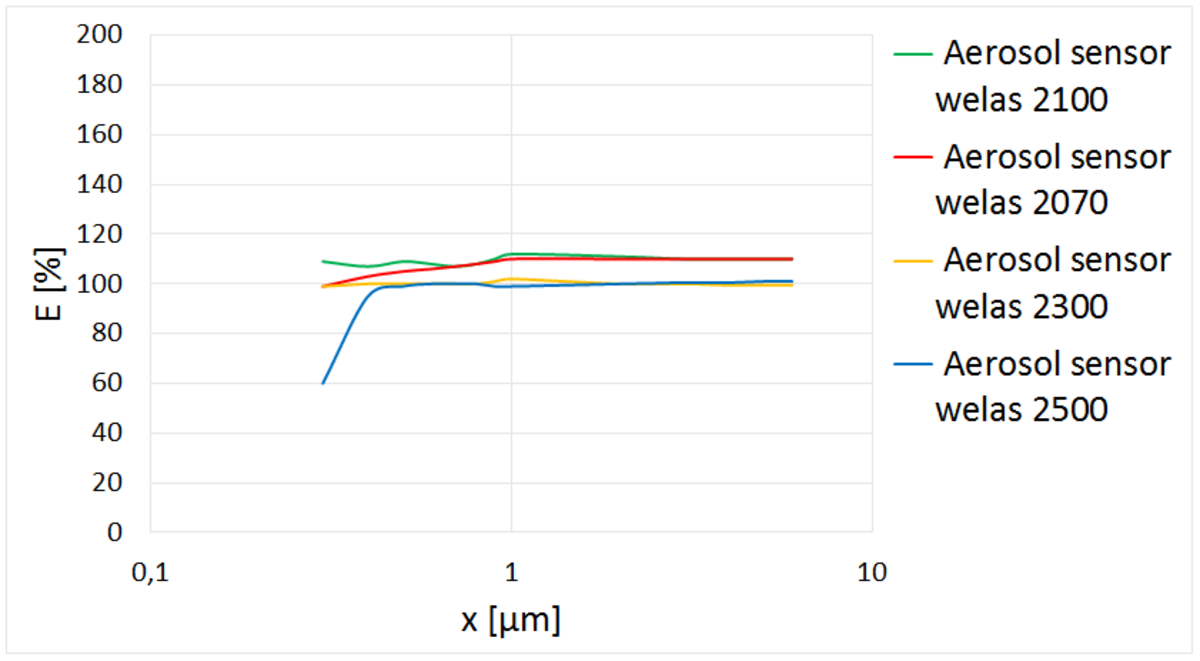
Graph 1: Counting efficiency of various sensors in relation to the welas® 2200 sensor (in the measuring range 0.2 – 10 µm)
Extension/Accessories
Special measuring cuvettes allow the use of the welas® aerosol sensors even under unusual measuring conditions. These are available:- heatable sensors up to 250 °C; higher temperatures on request
- pressure-resistant sensors up to 10 bar overpressure
- sensor resistant against chemically aggressive media
Bibliography
Publications
- Teng, Z.; Skønager, J.; Massling, A.; et al.: Characterizing aerosol sources based on aerosol optical properties and dispersion modelling in a Scandinavian Coastal Area; Aerosol Research read more
- Dupont, S.; Rajot, J.-L.; Lamaud, E.: Comparison Between Eddy-Covariance and Flux-Gradient Size-Resolved Dust Fluxes During Wind Erosion Events; Journal of Geophysical Research: Atmospheres read more
- Dupont, S.; Rajot, J.-L.; Labiadh, M.; et al.: Dissimilarity Between Dust, Heat, and Momentum Turbulent Transports During Aeolian Soil Erosion; Journal of Geophysical Research: Atmospheres read more
- Fernandes, R.; Dupont, S.; Lamaud, E.: Experimental evidence of dust flux size distribution variation along two consecutive erosion seasons; Aeolian Research read more
- Dupont, S.; Klose, M.; Irvine, M.R.; et al.: Impact of Dust Source Patchiness on the Existence of a Constant Dust Flux Layer During Aeolian Erosion Events; JGR Atmosphere read more
- Dupont, S.; Klose, M.; Irvine, M.R.; et al.: Journal of Geophysical Research: Atmospheres; Journal of Geophysical Research: Atmospheres read more
- Bächler, P.; Meyer, J.; et al.: Measurement of transient nanoparticle emissions of a municipal biomass incineration plant equipped with pulse-jet cleaned filters; Process Safety and Environmental Protection read more
- Dupont, S.: On the Influence of Thermal Stratification on Emitted Dust Flux; Journal of Geophysical Research: Atmospheres read more
- Fernandes, R.; Dupont, S.; Lamaud, E.: Origins of Turbulent Transport Dissimilarity BetweenDust and Momentum in Semiarid Regions; Journal of Geophysical Research:Atmospheres read more
- Dupont, S.: Scaling of Dust Flux With Friction Velocity: Time Resolution Effects; Journal ofGeophysical Research: Atmospheres read more
- Zinke, Julika; Nilsson, Ernst Douglas; et al.: Sea spray emissions from the Baltic Sea: comparison of aerosol eddy covariance fluxes and chamber-simulated sea spray emissions; Atmos. Chem. Phys., read more
- Alfaro, S.-C.; Bouet, C.; Khalfallah, B.; et al.: Unraveling the Roles of Saltation Bombardment and Atmospheric Instability on Magnitude and Size Distribution of Dust Emission Fluxes: Lessons From the JADE and WIND-O-V Experiments; Journal of Geophysical Research: Atmospheres read more
- Schade, S.; Seipenbusch, M.: ViralaerosoltransmissionofSARS-CoV-2fromsimulatedhumanemissioninaconcerthal; InternationalJournalofInfectiousDiseases
Benefits
Your special advantages
- The sensors are easily replaceable
- World's smallest and most robust sensors in the 2000 series
- Excellent agreement of all sensors regarding particle size and particle concentration
- Minimization of particle losses in long sampling lines by the easy installation of the sensor directly at the sampling point
- Sensors for in-situ measurements
- Measurement in explosive environments in the 2000 series (without heating)
- Easy to clean
- Simple operation
- Reliable function
- Low maintenance
- Reduces your operating costs
Applications
Individual solutions for various industries
- Determination of the separation efficiency of car interior filters, engine air filters, room air filters, compressed air filters, vacuum cleaner filters, cleanable filters, electrostatic precipitators, oil separators, cooling lubricant separators, wet scrubbers, cyclones, and other separators
- Isothermal and isobaric particle size and quantitative determination, for instance, in the automobile, chemical, pharmaceutical, and food industries
- Analysis of fast, transient processes
- Inspection of smoke detectors
- Particle formation for cloud formation
- Emission measurements
- Immission measurements
Technical features
In detail
- Measurement range (number C_N)
- 0 – 4 • 104 particles/cm3
- Measurement range (size)
- 0.2 – 105 µm (4 measurement ranges)
- Volume flow
- 5 l/min (others on demand)
- Thermodynamic conditions
- +10 – +40 °C, -100 – +50 mbarg
- Light source
- Xenon arc lamp 35 W
- Dimensions
- 50 • 250 • 100 mm (H • W • D)
- Weight
- Approx. 2.8 kg
